


Here at Porch Light Health, we know that comparing two medications that share the same active ingredient can feel confusing. It gets harder still when one is meant for pain and the other for recovery.
Suboxone and Belbuca both contain buprenorphine, yet they are prescribed for very different reasons and are not interchangeable. In this guide, we explain how they differ in uses, ingredients, dosing, cost, and side effects so you can have a more informed conversation with your provider.
If you or a loved one is exploring options for opioid dependence, our Suboxone treatment program can help you understand where these medications fit. Always talk with a qualified healthcare provider before starting, stopping, or switching any medication.
Belbuca is a prescription medication that uses buprenorphine as its active ingredient. Buprenorphine is a partial opioid agonist. That means it attaches to the same receptors in the brain as other opioids but produces a weaker, ceiling-limited effect.
As the NIH National Library of Medicine notes in its StatPearls review of buprenorphine, this ceiling effect can limit respiratory depression at higher doses, a key safety difference from full opioid agonists like morphine.
This formulation binds to those receptors with a significantly reduced risk of producing euphoria, which lowers its potential for misuse compared to full opioid agonists like morphine or oxycodone. The result is a useful tool for managing chronic pain, offering steady relief without the highs and lows of stronger opioids.
Belbuca is delivered as a buccal film, a thin strip placed against the inside of the cheek where it dissolves and is absorbed. It is approved specifically for chronic pain severe enough to require daily, long-term opioid treatment when other options are not adequate.
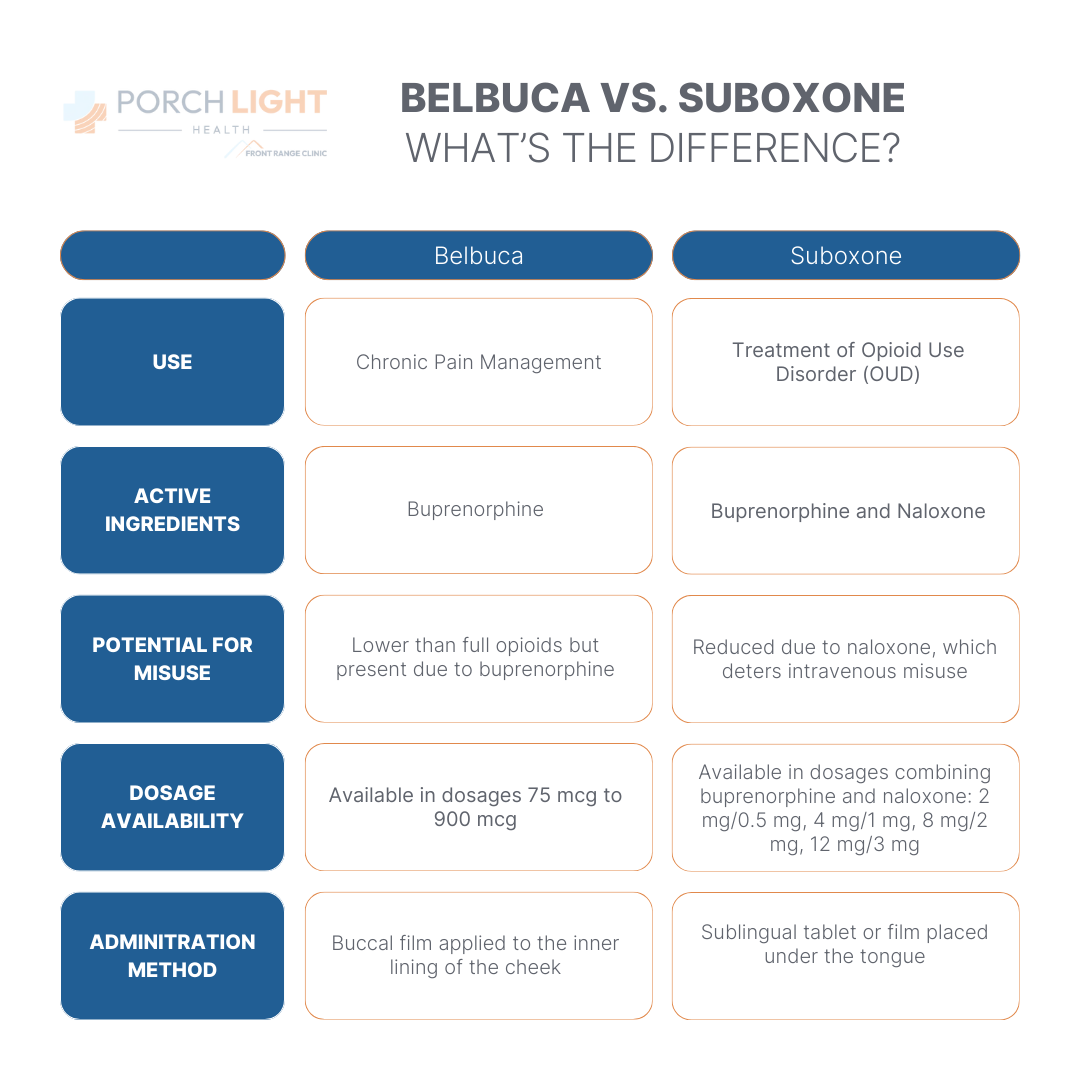
No. Although Belbuca and Suboxone both contain buprenorphine, they are not the same medication and serve different primary purposes. Some of the key differences include:
These distinctions make Suboxone and Belbuca non-interchangeable. Each is designed for a separate medical need. If your concern is reliance on prescription pain medication, our team treats prescription opioid dependence and can help you understand your options.
The table below summarizes how the two medications compare across the factors patients ask about most.
| Factor | Belbuca | Suboxone |
| Primary use | Chronic pain management | Treatment of opioid use disorder (OUD) |
| Active ingredients | Buprenorphine | Buprenorphine and naloxone |
| Misuse deterrent | None built in | Naloxone deters intravenous misuse |
| Form and delivery | Buccal film, applied to the inner cheek | Sublingual tablet or film, placed under the tongue |
| Available strengths | 75, 150, 300, 450, 600, 750, and 900 mcg | 2 mg/0.5 mg, 4 mg/1 mg, 8 mg/2 mg, 12 mg/3 mg |
| Dosing units | Micrograms (mcg) | Milligrams (mg) |
| Controlled substance | Schedule III | Schedule III |
| Approximate half-life | About 48 hours | About 37 hours |
| FDA-approved for addiction | No | Yes |
Dosing and pricing vary by individual, pharmacy, and insurance coverage. The strengths above reflect commonly available formulations and should be confirmed with your prescriber.
Suboxone combines buprenorphine with naloxone, pairing a partial opioid agonist with an opioid blocker. This combination helps relieve withdrawal symptoms, while the naloxone component discourages misuse if the medication is tampered with or injected. Recognized for its role in long-term opioid addiction management, Suboxone is a widely used medication for medication-assisted treatment (MAT).
Used as prescribed and combined with support, Suboxone offers several advantages.
It is still possible to overdose on Suboxone when it is misused or mixed with other depressants, which is one more reason provider oversight matters.
Belbuca offers its own set of advantages for the population it serves, which is patients living with chronic pain.
Belbuca can offer meaningful relief for long-term pain. Like all medications, it also carries potential side effects, and patients and providers should weigh the benefit of pain relief against possible adverse effects. Common side effects associated with Belbuca include:
Talk openly with your provider about any side effects. In many cases, they can be managed through dose adjustments, supportive care, or additional treatments.
Suboxone can play a pivotal role in recovery, but it also has potential side effects that are important to recognize and manage with a trained provider. Common side effects associated with Suboxone include:
Want a closer look at what to expect? Our overview of common Suboxone side effects explains how these reactions tend to present and when to contact your care team.
“Stronger” is not a straightforward comparison, because the two are dosed in different units and used for different goals. Belbuca is measured in micrograms and Suboxone in milligrams, and one microgram is one-thousandth of a milligram. The buccal film also absorbs differently than a sublingual film, so the numbers on the label do not translate directly between products.
What matters more than raw potency is fit:
The appropriate medication and strength are determined by a provider based on your medical history and treatment goals.
Both medications contain buprenorphine, which has a long duration of action, but their reported half-lives differ. Belbuca has an approximate half-life of 48 hours, while Suboxone is often cited at around 37 hours. A longer half-life can mean a more gradual decline in blood levels, which may influence how a medication is dosed and tapered.
These figures are averages. Several individual factors all affect how long a medication remains active:
For more detail on detection and clearance, see our guide on how long Suboxone stays in your system.
Cost is a common deciding factor, and the two medications differ notably here. Belbuca is generally more expensive, in part because it is available only as a brand-name product. Suboxone tends to be more affordable, especially since a generic buprenorphine and naloxone formulation became available in 2018.
Out-of-pocket cost still depends heavily on your insurance plan, pharmacy, dosage, and any savings programs. The most reliable estimate comes from your own pharmacy and insurer. We accept most major insurance plans and offer a sliding fee scale based on family size and income for patients who are uninsured or paying out of pocket.
Both medications incorporate buprenorphine, but they are tailored for distinctly different long-term goals.
The naloxone in Suboxone acts as a deterrent against misuse, particularly by injection, because naloxone can precipitate withdrawal when the medication is misused. This safety mechanism positions Suboxone as a common choice for the long-term treatment of OUD. It offers a balanced approach that reduces cravings and withdrawal symptoms while limiting the potential for misuse.
The dual-action formula can also support engagement in counseling and behavioral therapy. Its established use reflects a favorable safety and effectiveness profile for many patients in recovery over extended periods. You can learn more about our approach to opioid use disorder treatment and how medication fits into a complete plan.
Belbuca is formulated for chronic pain, using a buccal film that delivers buprenorphine for steady, long-lasting relief. It is intended for patients who need consistent opioid-level analgesia for conditions not adequately addressed by other treatments. Because its purpose is pain management rather than addiction treatment, Belbuca does not include naloxone.
A study in the Journal of Pain Research found that buprenorphine buccal film provided sustained pain relief and a favorable long-term safety profile in patients with moderate-to-severe chronic pain who required around-the-clock opioids. This supports its role as a steady option for the right candidates.
Buprenorphine’s partial agonist properties reduce the likelihood of euphoria and misuse. Even so, the absence of naloxone means some misuse potential remains, so long-term use warrants monitoring. Providers should weigh the risks and benefits carefully, especially for patients with a history of substance misuse.
This is a decision for your prescriber, never something to attempt on your own. Because both products contain buprenorphine, a provider-supervised switch generally does not require a washout period. Changing between buprenorphine formulations also does not carry the same risk of precipitated withdrawal as starting buprenorphine after a full opioid.
That said, the two are dosed very differently, and the buccal film has different bioavailability than a sublingual film, so doses do not convert one-to-one. Taking them together, or substituting one for the other without guidance, can lead to inadequate treatment or unexpected complications. If a switch is being considered, your care team will map out the timing and dose.
Yes. Both Belbuca and Suboxone are Schedule III controlled substances under federal law because they contain buprenorphine, an opioid. Schedule III status reflects a recognized medical use along with a moderate potential for dependence and misuse. This is why both require a prescription and ongoing provider oversight.
There is no single better option, only the option that fits the situation. The decision hinges on individual needs, specifically whether the primary concern is chronic pain management or recovery from opioid addiction.
For patients with chronic pain who also have a history of OUD, a provider might consider Suboxone as part of a comprehensive plan. That choice rests on a careful assessment of medical history, pain needs, and risk factors for misuse, and it often involves dual diagnosis treatment when pain and addiction overlap.
For patients whose primary issue is opioid dependence, Suboxone is typically the medication designed for that purpose. Consulting a healthcare professional is essential to selecting the most appropriate medication and building a personalized approach.
If comparing these medications still feels like a lot, that’s completely normal. Our team is here to help you understand your options, not to judge or pressure you. A confidential call takes just a few minutes and can answer your questions about treatment, insurance, and what comes next.
Call us at 866-935-5183 for a confidential conversation, or contact us online whenever you feel ready. There is no wrong time to reach out.
Can Belbuca be used to treat opioid addiction?
Belbuca is approved for chronic pain, not as a primary treatment for opioid use disorder. Suboxone is the buprenorphine product formulated for OUD because it pairs buprenorphine with naloxone. A provider determines the right medication for your goals.
Can Suboxone be used for pain?
Suboxone is not typically prescribed for pain management. Its purpose is to treat opioid dependence by easing withdrawal and reducing cravings. In specific cases, a provider may consider buprenorphine for pain, but that is an individualized clinical decision.
Does Belbuca contain naloxone?
No. Belbuca contains only buprenorphine. Naloxone is the ingredient that distinguishes Suboxone and is included to deter misuse.
Is Belbuca less addictive than Suboxone?
Both contain buprenorphine, a partial opioid agonist with a lower misuse potential than full opioids, and both are Schedule III controlled substances. Suboxone adds naloxone as a misuse deterrent, while Belbuca relies on lower dosing and provider monitoring. Neither is risk-free.
Can you take Belbuca and Suboxone together?
No. You should not combine them or switch between them without explicit medical guidance. Doing so can lead to inadequate treatment or unexpected complications. Any change should be directed by your prescriber.
Here at Porch Light Health, with locations across Colorado and New Mexico, we focus on combating opioid addiction through accessible treatment options, including mobile clinics and telehealth. As a medication-assisted treatment provider, we offer a comprehensive approach to recovery from OUD that blends medical expertise with compassionate care.
You do not have to navigate this for yourself or a loved one alone. We will help you understand your options and build a plan that fits your life.
Ready to take the first step? You can contact the Porch Light Health team to talk through next steps, or find a clinic near you to get started.
Call us anytime at 866-935-5183.